ADHD assessment tools
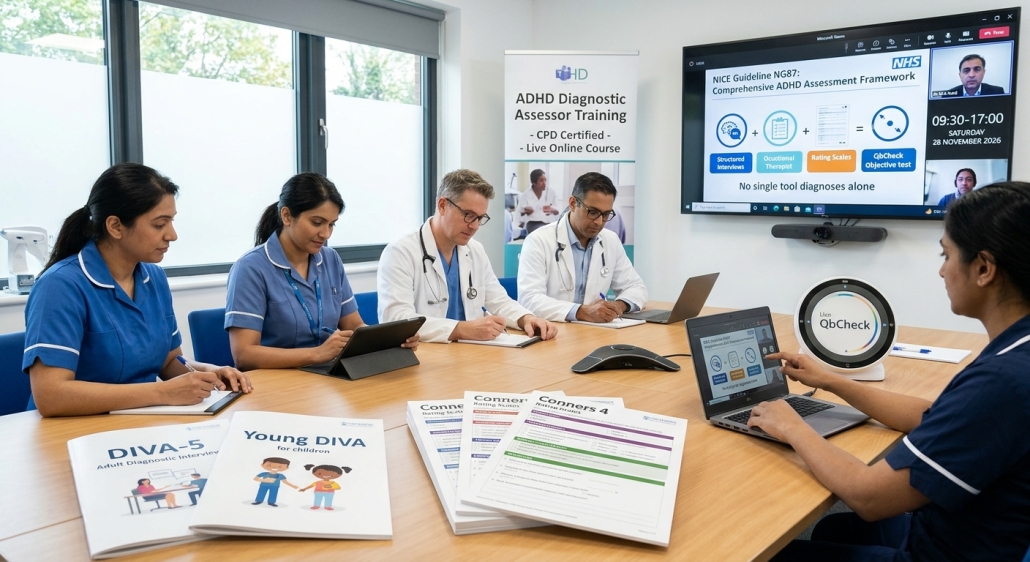
If you are training to assess ADHD in the UK, you will keep meeting the same four tools: DIVA-5, Young DIVA, Conners 4 and QbCheck. Each does a different job. None of them can diagnose ADHD on its own.
This guide explains what each tool is, when clinicians use it and how it fits into a full assessment that follows NICE guideline NG87. It is written for registered healthcare professionals and is general information rather than clinical advice.
The short version
- DIVA-5 and Young DIVA are structured interviews that map the history against DSM-5 criteria.
- Conners 4 is a set of rating scales that gathers views from several people.
- QbCheck is a computerised objective test of attention, impulsivity and movement.
- The diagnosis still comes from your clinical judgement, based on the whole picture.
Why no single ADHD assessment tool is enough
NICE NG87 describes ADHD diagnosis as the result of a comprehensive assessment. That means a full clinical and psychosocial assessment, a developmental and psychiatric history, symptoms across different settings, collateral information where appropriate and a mental state assessment. Rating scales and structured tools add useful information to that picture. They do not replace it.
A high score on a questionnaire can have many explanations, including anxiety, trauma, low mood, poor sleep, autism or substance use. A normal score can still sit alongside ADHD, particularly in people who have learned to mask. This is why the tools below work best as a set, used by someone who understands what each one can and cannot tell them.
At a glance: the four tools compared
| Tool | What it is | Typically used with | Main source of information |
|---|---|---|---|
| DIVA-5 | Structured diagnostic interview | Adults | The patient, plus a partner or family member where possible |
| Young DIVA | Structured diagnostic interview | Children and young people | Parent or carer, with input from the young person |
| Conners 4 | Rating scales | Children and young people | Parent, teacher and self-report forms |
| QbCheck | Computerised objective test | Children, young people and adults | Performance data and motion tracking during the test |
DIVA-5: the structured interview for adults
DIVA-5 is the Diagnostic Interview for ADHD in Adults, updated to match DSM-5. It walks you through the 18 DSM-5 symptom criteria, covering both inattention and hyperactivity-impulsivity. For each one, it asks about the person’s current life and about their childhood.
That childhood question matters. DSM-5 requires several symptoms to have been present before the age of 12, so an assessment that only looks at the present is incomplete. DIVA-5 also gives concrete examples of how each symptom can show up in adult life, which helps you probe beyond a simple yes or no. It then looks at impairment across areas such as work or education, relationships, leisure and self-image.
Used well, it keeps the interview structured without making it feel like a tick-box exercise. Used badly, it becomes a script that gets read out while the person in front of you is not really heard.
Young DIVA: the equivalent for children and teenagers
Young DIVA follows the same logic for younger people. It is normally completed with a parent or carer, with the child or young person contributing as far as their age and understanding allow. The questions are tied to the same DSM-5 criteria. They are phrased around everyday behaviour at home, at school and with friends.
Assessing children brings extra considerations, including developmental stage, family context, school information and safeguarding. The UK framework for this age group is CAAQAS, which you can read about in our guide to who can diagnose ADHD in the UK.
Conners 4: rating scales from more than one viewpoint
The Conners 4 scales are questionnaires, not interviews. Their main strength is that different people can complete them. In children and young people that usually means a parent, a teacher and the young person themselves. Comparing those views shows you whether difficulties appear in every setting or only in some.
Setting matters because ADHD symptoms should be present in more than one environment. A child who struggles only in one classroom might have a different explanation, such as a poor fit with a particular teacher, bullying or an unmet learning need. Conners also publishes an adult rating scale for adult assessments.
Remember that scores reflect the views of the person completing the form. Teachers, parents and young people can all see the same child differently. Treat a Conners result as one input to weigh, not as a verdict.
QbCheck: objective data on attention, impulsivity and movement
QbCheck is a computerised test that measures how a person performs on an attention task while tracking their movement. It produces objective data on attention, impulsivity and activity, which sits alongside the interview and the rating scales.
Clinicians value it because it adds a different kind of evidence. It is not a diagnostic test by itself. People without ADHD can score atypically. People with ADHD can score within the typical range. The result always has to be interpreted in context. Many services use it to support a decision, to inform discussion with the patient and to add measurable detail to the report.
How the tools fit together in a real assessment
Every service organises its pathway differently. A typical sequence looks like this:
- Screen the referral and gather background information in advance, including school reports or collateral where available.
- Complete rating scales such as Conners 4 so you have multiple viewpoints before the appointment.
- Carry out the structured interview (DIVA-5 or Young DIVA) alongside a full psychiatric and developmental history.
- Complete a mental state assessment and consider risk.
- Add objective testing such as QbCheck if your service uses it.
- Weigh the evidence, consider alternative explanations and co-existing conditions, then reach a clinical decision.
The final step is where skill really shows. The tools gather information. You still have to decide what it means.
Common mistakes when using ADHD assessment tools
- Letting a score decide the diagnosis. Scores support judgement. They do not replace it.
- Skipping childhood evidence. Adult symptoms need a developmental history behind them.
- Missing masking. Some people, particularly women and girls, compensate so well that the surface picture looks typical.
- Overlooking differentials. Anxiety, trauma, sleep problems, mood disorders and autism can all look like ADHD or sit alongside it.
- Writing a report that only lists results. A good report explains the reasoning, maps the findings to DSM-5 and sets out clear recommendations.
Access and licensing also differ between these tools, so check what your service has in place before assuming you can use a particular one.
Learn to use these tools with a consultant psychiatrist
The ADHD Diagnostic Assessor Training is a CPD-certified, one-day live online course led by Dr M A Faridi FRCPsych, a consultant child and adolescent psychiatrist. It is for registered healthcare professionals who assess ADHD or want to start. Participants use DIVA-5, Young DIVA, Conners 4, QbCheck and school reports, then practise in two live case simulations and learn how to structure a report.
The course gives 6 CPD hours and is aligned with NICE NG87. It does not cover prescribing. It also does not give anyone authority to diagnose independently. That depends on your registration, experience, supervision and local governance. The assessor framework page explains how to think about your own pathway.
Next course: Saturday 28 November 2026
Live on Microsoft Teams, 09:30 to 17:00. £297. Small groups, so there is time for your own cases and questions.
Prefer to read more first? Have a look at the full course programme or the FAQs.
Frequently asked questions
Can DIVA-5 diagnose ADHD by itself?
No. DIVA-5 structures the interview and links the history to DSM-5 criteria, but the diagnosis depends on the full assessment and your clinical judgement.
Is a Conners 4 score enough to diagnose ADHD?
No. NICE NG87 is clear that diagnosis rests on a comprehensive assessment. Rating scales add information from different people and settings, but they cannot stand alone.
Is QbCheck required for an ADHD assessment?
Not necessarily. Some services use it routinely and others do not. It adds objective data, but the assessment is valid without it when the rest of the evidence is thorough.
Do I need experience of ADHD assessment before taking the course?
No. The course is designed for registered clinicians who are new to formal ADHD assessment. Experienced assessors also use it to sharpen their approach to complex differentials and report writing.


Leave a Reply
Want to join the discussion?Feel free to contribute!